


 Lowest Price Policy^
 Free delivery* with
 4 hour Click & Collect
 Easy in-store Returns
Pets & Wildlife
How to make a pet grooming kit for home

Always check with your local council before building or buying a chicken coop as there may be rules in your area for keeping chickens and whether roosters are allowed.
When buying chickens, keep in mind different breeds require different amounts of space, so it's important to ask the breeder about this when buying them.
If you plan to let your chickens run around the yard most of the day, you'll only need a small coop for them to sleep in. However, if they're going to be confined a lot, you need to make sure they have enough room to be comfortable.
Generally, a structure measuring 1.5m x 2m is fine for up to 6 chickens.
Remember though, all chickens should be let out for a little while each day so they can exercise and flap their wings.
You can buy a chicken coop ready made or build a chicken coop from scratch.
Typically, the structure is made from particle board, plywood or timber; while the roof is made from PVC, sheet metal or tiles. But you can also use recycled materials such as chicken wire, corrugated iron and old pallets. You can even convert an unused cubby house that the kids have grown out of.
If you choose to build your own chicken coop, make sure you design it so you have easy access to all areas to clean and include lots of flaps and doors that you can open but secure if needed.
Lastly, ensure your coop has nests for the chickens to lay eggs. Each nest box must be a minimum of 30cm x 30cm, and you'll need one for every 2–3 chickens.
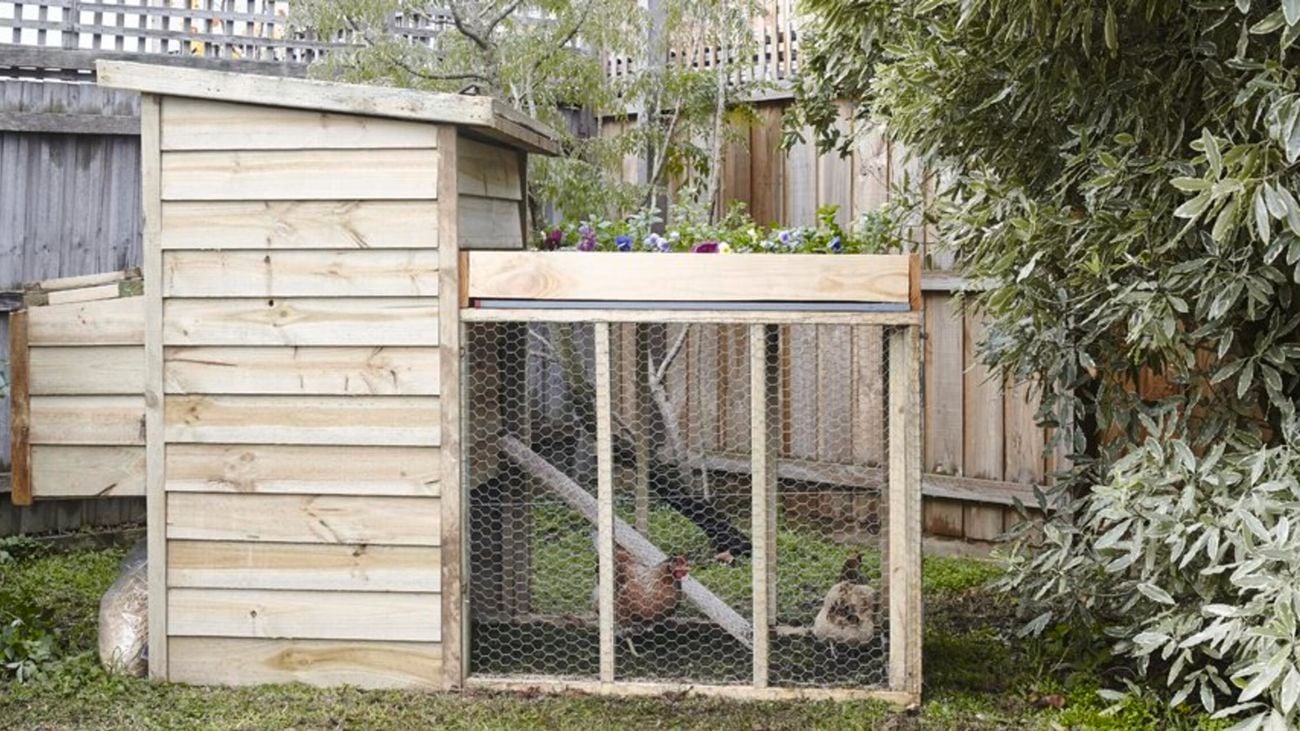
You don't need a huge backyard to keep chickens. Ideally the coop should be on grass or dirt as your chooks will love to peck the ground and search for insects.
Ensure it's placed in a shaded, level part of the yard that's dry. It's also important to secure your chicken coop so your chickens are safe from dogs, foxes and rats.
You can do this by moving the coop onto a paved area at night time so predators can't dig under and into it.
Happy chickens lay the tastiest eggs. Bedding, food and water are the three key ingredients required to keeping a happy chook.
The great thing about chickens is they'll eat most of your kitchen scraps, excluding meat of course. Course river sand is a great way to aid their digestion, so scatter it on the bottom of your coop, preferably on pavers.
You'll also need to install a waterer that holds ample water and is held off the ground so it doesn't get full of dirt and food. Make sure you change the water every day.
Asbestos, lead-based paints and copper chromium arsenic (CCA) treated timber are health hazards you need to look out for when renovating older homes. These substances can easily be disturbed when renovating and exposure to them can cause a range of life-threatening diseases and conditions including cancer. For information on the dangers of asbestos, lead-based paint and CCA treated timber and tips for dealing with these materials contact your local council's Environmental Health Officer or visit our Health & Safety page.
When following our advice in our D.I.Y. videos, make sure you use all equipment, including PPE, safely by following the manufacturer’s instructions. Check that the equipment is suitable for the task and that PPE fits properly. If you are unsure, hire an expert to do the job or talk to a Bunnings Team Member.


