


 Lowest Price Policy^
 Free delivery* with
 4 hour Click & Collect
 Easy in-store Returns
How to plant and grow a cherry tree

What you need to know about a cherry tree
Name: sweet cherry (Prunus avium), sour cherry (Prunus cerasus).
Height: 10m+ if left unpruned, but generally 5-6m, with dwarf cultivars growing 1.5–2m.
Foliage: deciduous.
Climate: prefers cool climates, but will grow in warm, arid and semi-arid climates.
Soil: prefers deep, well-drained soils enriched with compost and decomposed manure.
Position: full sun, protected from strong winds. Can grow in part shade in hot, dry areas.
Flowering and fruiting: flowers appear in spring followed by a crop of delicious cherries in summer.
Feeding: mulch with compost in spring and autumn.
Watering: regular watering throughout summer when the weather is hot and dry and cherries are setting fruit. Avoid wetting fruit and foliage.
Appearance and characteristics of the cherry tree
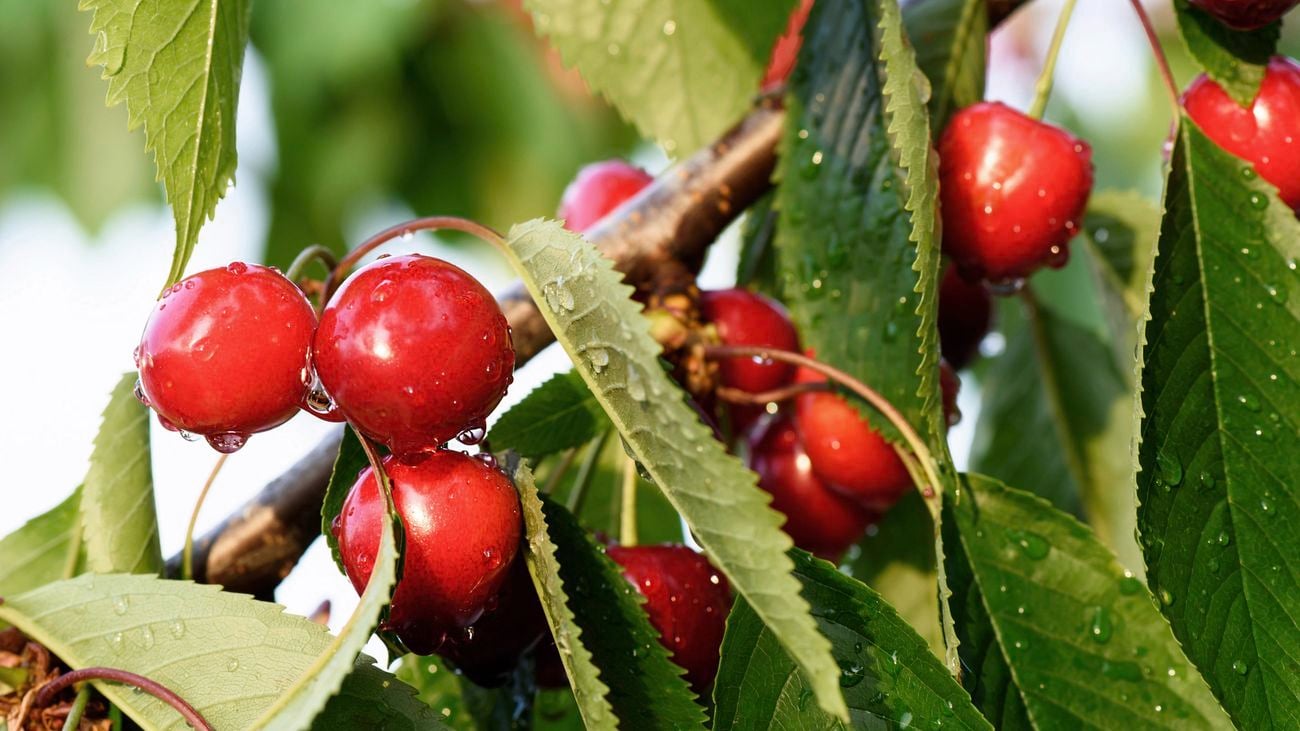
The cherry is a tall, narrow tree. Deciduous, it loses its leaves in winter and flowers on bare stems in spring. Foliage emerges after the flowers, and fruit develops in summer.
Uses for a cherry tree
Cherries can be planted quite close together to form an edible deciduous hedge, allowing sunlight (and prying eyes) to penetrate in winter. Suitable for gardens of all sizes – even pots, depending on variety – cherries are a highlight of the summer garden.
How to plant and grow cherry trees in your garden
Always plant at least two cherry trees close together to improve pollination and fruiting. Even self-pollinating types benefit from having another tree close at hand.
Prepare the soil prior to planting with compost and decomposed manure. Stake bare-rooted trees at planting in winter. Potted plants can be planted year-round, although the height of summer should be avoided, as cherries do not respond well to heat stress during establishment.
Planting cherries from pots
- Water the pot prior to preparing the planting hole.
- Dig a hole twice the size of the pot and backfill so that the potting mix inside the pot is positioned at the same height as the surrounding soil.
- Gently remove the tree from the pot and place it in the centre of the hole.
- Backfill with soil and firm down to remove any air holes around the roots.
Planting bare-rooted cherry trees in the garden
- Unwrap the tree roots and soak in a bucket of diluted seaweed solution while you prepare the hole.
- Dig a hole at least 40cm wide and 30cm deep. Backfill a mound in the centre of the hole, and check that the tree is level in the hole. The mark on the trunk where the previous soil level should be level with the surrounding soil.
- Fan the roots out down the mound and backfill with soil.
- Firm the soil down to remove any air holes around the roots.
- Water in well and mulch with pea straw, sugarcane or lucerne. Apply an organic mulch like pea straw or sugarcane mulch to prevent weeds.
Caring for a cherry tree
For best results, follow these steps when caring for your cherry tree:
- Cherry trees need cold winter nights to set fruit, and require regular water during summer.
- Mulch with compost in spring and again in autumn.
- Stake for the first few years to allow the roots to establish.
- Avoid wetting the fruit, as even summer rain can cause your cherries to split. This is vital in areas with wet or humid summers.
- Netting is essential to protect developing fruit from birds.
- Pear and cherry slug can quickly defoliate your tree. Although it is not necessarily life or death, it does weaken your tree, so treatment is recommended.
- Depending on the variety, cherries will be ready to harvest either early, mid or late summer. Check their colour, size and flavour to determine optimal harvest date.
Once established, bi-weekly watering will usually suffice unless weather is extremely hot and dry. Water more regularly throughout summer, during fruit development.
How and when to prune your cherry tree
Prune only to remove last season's fruiting branches and to minimise overall height for netting. This is best done in early spring, rather than winter.
Cherries can also be trained to espalier, producing their harvest flat against a wall or fence.
Diseases and pests associated with cherry trees
Birds are the number one pest when it comes to your harvest, quickly decimating your crop in the time it takes you to go and get your net. Be vigilant and net early to ensure you get to reap the rewards of your labour.
Pear and cherry slug is the other major pest for cherry trees. These small slugs can be found munching their way through the foliage. They are best treated with a suitable insecticide, like Yates Success Ultra.
How to propagate your cherry tree
Most cherries are grafted onto dwarf rootstocks, however they can be grown from a cherry pit or seed. Grafting helps to reduce the overall size of the tree-seed-grown cherries can reach up to 20m! Cuttings can also be used, but you may end up with a tree much larger than you want.
Growing cherries from seed
- Collect fresh cherry pits and place them in moist perlite in the crisper section of your fridge.
- Leave for 3–4 months to replicate a cold winter, then plant into seed-raising mix.
- Continue to pot into progressively larger pots until the tree is at least 60cm high. At this time the tree can be transplanted out into the garden.
Cherry tree grafting
Grafting is an advanced method of propagation where the desired cherry variety is grafted onto the rootstock of a tree that offers other qualities, usually dwarfing characteristics.
Safety tip
If using products to deal with pests, diseases or weeds, always read the label, follow the instructions carefully and wear suitable protective equipment. Store all garden chemicals out of the reach of children and pets.
If you like this then try
Dwarf fruit trees: perfect fruit trees for small gardens and pots.
Pear: a close relative to the cherry that shares similar growing conditions.
Plum: one of the easiest and most rewarding fruit trees to grow.
Start planting today
Check out our huge range of plants now and get your garden growing!


More D.I.Y. Advice


Asbestos, lead-based paints and copper chromium arsenic (CCA) treated timber are health hazards you need to look out for when renovating older homes. These substances can easily be disturbed when renovating and exposure to them can cause a range of life-threatening diseases and conditions including cancer. For information on the dangers of asbestos, lead-based paint and CCA treated timber and tips for dealing with these materials contact your local council's Environmental Health Officer or visit our Health & Safety page.
When following our advice in our D.I.Y. videos, make sure you use all equipment, including PPE, safely by following the manufacturer’s instructions. Check that the equipment is suitable for the task and that PPE fits properly. If you are unsure, hire an expert to do the job or talk to a Bunnings Team Member.