


 Lowest Price Policy^
 Free delivery* with
 4 hour Click & Collect
 Easy in-store Returns
Retail crime
Combatting retail crime
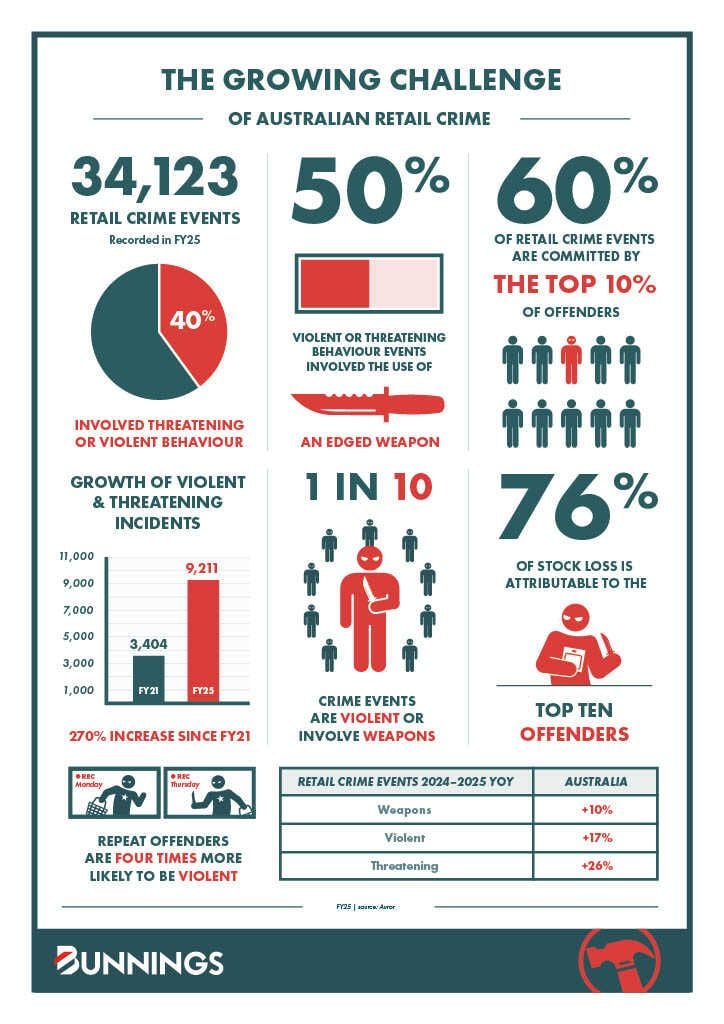
Retail crime continues to have a significant impact on retailers across Australia, and we are seeing concerning incidents of violent and threatening incidents in our stores.
No one should have to experience abuse, threats or violence simply for doing their job or going about their day.
The safety of our team, customers and suppliers is our highest priority. That’s why we invest heavily in a range of measures to create a safe, welcoming environment in our stores and to prevent incidents before they escalate.
What we’re doing to keep people safe
Across our store network, we use a combination of people, training, design and technology to deter retail crime and respond quickly when incidents occur. These measures include:
- Investing more than $10 million each year in security, including tactical guards
- Trialling entry and exit gates in selected stores
- Team member body-worn cameras
- CCTV and licence plate recognition
- Store security design, including physical barriers, locked cabinets and security tagging for high-value items
- Push-to-talk handsets with duress functionality and discreet distress signals
- Team training focused on safety and de-escalation
- Clear in-store signage and PA announcements reinforcing respectful behaviour — “It’s not OK”
- Banning notices and prohibition letters to offenders excluding them from our stores
- Processes for responding to aggressive or substance-affected behaviour
- Loss prevention reporting tools and the Auror platform
We also work closely with governments, industry bodies and unions to strengthen protections for frontline retail workers and support legislative change that helps keep people safe.
Violent and threatening retail crime is a workplace safety crisis. Behind the statistics are real people who are being put in harm’s way.
We have a duty of care to provide safe workplaces and shopping environments. Safety must be treated as a fundamental workplace obligation, not an accepted risk of retail. That responsibility demands ongoing, tangible action, which is why we continue to strengthen the measures in place to protect our people and those who visit our stores.
Facial Recognition Technology (FRT)
While we do not currently use this technology, as part of our broader approach to safety, we believe Facial Recognition Technology (FRT) is a critical tool to help prevent violent and threatening incidents involving known repeat offenders.
Between November 2018 and November 2021, we trialled the use of Facial Recognition Technology in 63 stores across Victoria and New South Wales to keep our team and customers safe and prevent unlawful activity by known repeat offenders.
How it worked
The FRT system we used at that time operated in the following way :

Outcome of review of the Office of the Australian Information Commissioner Determination
On 29 October 2024, the Office of the Australian Information Commissioner (OAIC) released its Determination about our use of FRT. The Determination found that Bunnings’ use of the FRT technology was in breach of the Privacy Act.
We sought a review of the OAIC’s Determination before the Administrative Review Tribunal (ART). The ART handed down its decision on 4 February 2026.
The ART found that Bunnings’ use of the FRT system was a permitted use of the technology under the privacy laws.
The ART recognised that Bunnings’ use of the FRT system was for the purpose of responding to the significant level of retail crime being committed by repeat offenders, enabling us to identify them at the time they entered a Bunnings store. This enabled us to take appropriate action and put us in the best position to try to prevent them from engaging in further theft or violence.
Other findings of the Privacy Commissioner and the ART
The ART confirmed that Bunnings was entitled to use FRT for the purpose of combatting very significant retail crime and protecting our team members and customers from violence, abuse and intimidation in our stores. However, the ART also affirmed some of the Privacy Commissioner’s findings in the Determination, including that we:
- should have included information in our privacy policy about the collection of facial images of individuals and the creation of biometric templates to compare them against the biometric templates of known offenders (as explained above) for the purpose of protecting our customers and team members; and
- our in-store notices should have conveyed information about the collection of sensitive information through the FRT system, the purpose for which it was occurring and the consequences to individuals of our not being able to collect the information.
How can you contact us about privacy?
You can direct any questions, requests for further information or complaints about privacy to the Bunnings’ Privacy Officer, using the contact details below.
Bunnings’ Privacy Officer
Botanicca 3 - Level 2 East Tower, 570 Swan Street,
BURNLEY VIC 3121
Locked Bag 3004, HAWTHORN VIC 3122,
AUSTRALIA
Email: privacy@bunnings.com.au
We’d like the chance to resolve any complaints you have and encourage you to call or write to us about your concerns. You can also contact the OAIC at the details below:
Office of the Australian Information Commissioner
Website: www.oaic.gov.au
Phone: 1300 363 992
Looking ahead
While FRT is not currently in use in our Australian stores, we are carefully considering how it could be used responsibly in the future to keep our team and customers safe from repeat offenders.
Following our assessment in New Zealand, we're introducing FRT in our New Zealand stores to help keep our customers and team members safe. You can read more on that here.